3 Answers - Sort by: Date | Rating
It is still not known exactly how a cat purrs (being the enigmatic creatures that they are...), however, it is known that all the purring sounds are produced by vibrations. In a cat's throat the vibrations happen when the major blood vessels which surround the vocal chords are expanded.
Cats actually have two sets of vocal chords. One set is called the false or superior chords, the other the true or inferior chords. The false chords are the ones which produce the purring, the other chords are responsible for the other cat noises such as miaows and cries.
All cats purr or have the ability to purr. Some make very little noise and others will purr on a range of two to three notes.
We always associate purring with a happy cat, but sometimes, if a cat is in deep pain, after an operation to remove a leg etc, it will purr as a signal of the pain. But 99.9999% of the time, a purring cat is a contented cat !
Cats actually have two sets of vocal chords. One set is called the false or superior chords, the other the true or inferior chords. The false chords are the ones which produce the purring, the other chords are responsible for the other cat noises such as miaows and cries.
All cats purr or have the ability to purr. Some make very little noise and others will purr on a range of two to three notes.
We always associate purring with a happy cat, but sometimes, if a cat is in deep pain, after an operation to remove a leg etc, it will purr as a signal of the pain. But 99.9999% of the time, a purring cat is a contented cat !
0
0
When something tastes good, or you feel pleased about something, you might make a sound like "Mmmm—mm!" When a cat wants to express contentment, it purrs!
The purring sound is caused by the vibration of the cat s vocal cords. When
a cat takes air into its lungs, the air passes through the voice box that contains the vocal cords. If the cat then wants to express its satisfaction about something, it will allow the vocal cords to vibrate as the air passes in and out of the lungs during breathing. When it chooses not to purr, the passing air does not affect the vocal cords—and no purr!
Of course when we think of "cat", we usually mean only the domesticated cat. But there are many other members of the cat family. Did you know that the lion, tiger, leopard, cougar, jaguar, ocelot, and lynx are also members of the cat family?
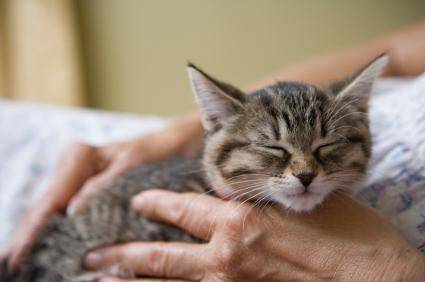
When it comes to making sounds, our own domesticated cat not only purrs, it can also meow, howl, and scream. The other kinds of cats make different sounds. The lion and tiger can roar. The jaguar and leopard make a sound that is described as a hoarse cough or bark.
But an interesting thing about the lion, tiger, jaguar, and leopard is that because of a difference in the formation of certain bones in the throat, they cannot purr!
But all cats, large or small, have-the same general proportions of the body. If you blew up a picture of a cat to a very large size, you would see that it looks very much like a tiger.
The purring sound is caused by the vibration of the cat s vocal cords. When
a cat takes air into its lungs, the air passes through the voice box that contains the vocal cords. If the cat then wants to express its satisfaction about something, it will allow the vocal cords to vibrate as the air passes in and out of the lungs during breathing. When it chooses not to purr, the passing air does not affect the vocal cords—and no purr!
Of course when we think of "cat", we usually mean only the domesticated cat. But there are many other members of the cat family. Did you know that the lion, tiger, leopard, cougar, jaguar, ocelot, and lynx are also members of the cat family?
When it comes to making sounds, our own domesticated cat not only purrs, it can also meow, howl, and scream. The other kinds of cats make different sounds. The lion and tiger can roar. The jaguar and leopard make a sound that is described as a hoarse cough or bark.
But an interesting thing about the lion, tiger, jaguar, and leopard is that because of a difference in the formation of certain bones in the throat, they cannot purr!
But all cats, large or small, have-the same general proportions of the body. If you blew up a picture of a cat to a very large size, you would see that it looks very much like a tiger.
0
0
A cat giving birth also purrs, she is surely in pain so it must also be a signal of comfort, and safety.
0
0
- Why Do Cats Growl?
- When Was The First Spade Invented?
- Why Is My Cat So Lazy?
- Why Is My Cat Sleep Alot And Eat Alot But Never Do Anything In Hte House?
- Why Is My Cat Afraid Of Me When I Let Him Go But When Hes In My Lap He Feels Comfortable?
- When Do Mother Cats?
- Is SOAP Secure?
- My Cat Is Scratching All Her Fur Out But I Can't Bather Her Cuz She's An Outside Cat. What Can I Give Her/ Buy For Her?
- M Cat Left For 3 Hours To Another House That Had Male Cats And Came Home To Have Her Sister Hissing At Her..why?
- My Cat Has Been Diagnosed With Kidney Disease And Will Not Go In The Litter Box?
- How Much Thin Set Do I Need?
- How Big Should Your Cat Be At 6 Months?
- What Did The First Bus Look Like?
- How Long Is A Cats Period?
- What Are The Symptoms Of Cats Drinking Rusty Water?
- How To Deliver Welcome Speech?
- How Does A Starfish Care For Its Young?
- Who Makes First Soap In The World?
- Who Plays Cat?
- For A Cat How Long Does Ovulation Occur In Mating?
- Why Do Cats Purr?
- Do Cats Purr During Labour?
- Can Wild Cats Purr?
- What Does Purr Mean?
- Why Does My Cat Not Purr?
- Why Doesn't My Cat Purr?
- Can Lions Purr?
- How Do Kittens Purr?
- Why Doesn't My Kitten Purr?
- Do Tigers Purr?
- Why Does Guinea Pig Purr?
- Why Does My 8 Month Old Kitten Suckle On My Shirt And Purr?
- Why Does My 7 Weeks Year Old Kitten Meow And Hiss Until I Pick Him Up, Then He'll Purr?
- What Does "Love To Work The Kitty Like Purr, She Loves To Stir It Up Purr" Means?

New Comment - Comments are editable for 5 min.